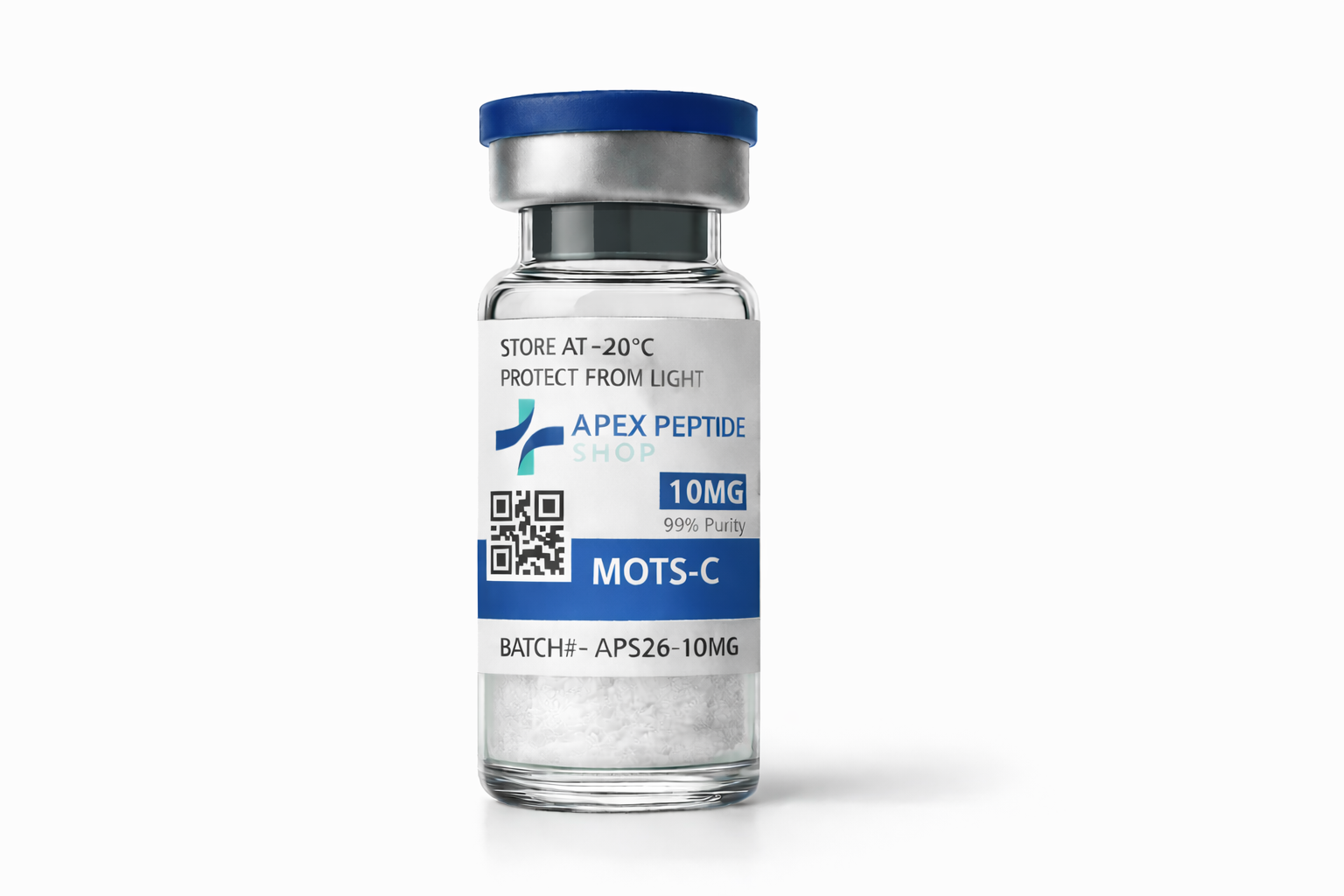
MOTS-c Peptide – Mitochondrial-Derived Metabolic Research Peptide
MOTS-c (Mitochondrial Open Reading Frame of the 12S rRNA Type-c) is a mitochondrial-derived peptide widely studied in metabolic regulation, cellular energy balance, and mitochondrial signaling research. As a short bioactive peptide encoded within mitochondrial DNA, MOTS-c has gained significant attention in laboratory research exploring metabolism, stress response pathways, and cellular adaptation mechanisms.
What Is MOTS-c Peptide?
MOTS-c is a naturally occurring peptide encoded by mitochondrial DNA and translated within cells. In research settings, it is investigated for its involvement in metabolic homeostasis, insulin signaling pathways, and mitochondrial-to-nuclear communication.
Its unique origin from mitochondrial genetic material makes MOTS-c Peptide an important compound in studies focused on:
-
Cellular energy regulation
-
Mitochondrial signaling networks
-
Adaptive stress-response pathways
-
Metabolic pathway modulation
Key Research Areas & Observations
Scientific literature frequently references MOTS-c Peptide in studies related to:
🔬 Metabolic Regulation Research
Explored in laboratory models evaluating glucose metabolism, lipid utilization, and cellular energy balance.
🧬 Mitochondrial Signaling Pathways
Studied for its role in mitochondrial-to-nuclear communication and transcriptional regulation.
⚙️ Cellular Stress Response
Referenced in experimental research analyzing adaptive cellular responses to metabolic stress.
🧪 Gene Expression & Pathway Modulation
Used in molecular biology studies investigating signaling cascades and regulatory protein activation.
Laboratory Applications
MOTS-c peptide is primarily utilized in:
-
Metabolic and bioenergetics research
-
Mitochondrial function studies
-
Cellular adaptation and stress-response experiments
-
Molecular and transcriptional pathway analysis
Experimental concentrations vary depending on assay design, model system, and laboratory protocol.
Product Highlights
-
High-purity MOTS-c peptide
-
Research-grade quality
-
No fillers, additives, or excipients
-
Manufactured under strict laboratory standards
-
Suitable for in vitro and controlled experimental research
MOTS-c ( Mitochondrial Open Reading Frame of the 12S rRNA-c ) is a
mitochondrially encoded research peptide that plays a role in
cellular energy metabolism and metabolic regulation .
In laboratory research, MOTS-c is applied to
study the interaction between mitochondrial activity, insulin signaling, and fatty acid metabolism in vitro. MOTS-c is produced to the highest laboratory standards and verified via
High-Performance Liquid Chromatography (HPLC) to ensure a purity of ≥ 99%.
Each batch is suitable for controlled research environments and biochemical applications.
Important specifications
| Feature |
Value / explanation |
| Name |
MOTS-c Peptide |
| Molecular formula |
C294H451N81O83S |
| Molecular weight |
≈ 2171 Da |
| Form |
Lyophilisate (dry powder) |
| Purity |
≥ 99% (HPLC tested) |
| Storage conditions |
Store refrigerated, protected from light and moisture. |
Research relevance
- Under investigation for its role in cellular energy metabolism, metabolic homeostasis, and stress response .
- Interesting for studies of insulin sensitivity, fatty acid combustion and mitochondrial signaling pathways .
- Promising research model in the study of aging, metabolism and energy balance .